
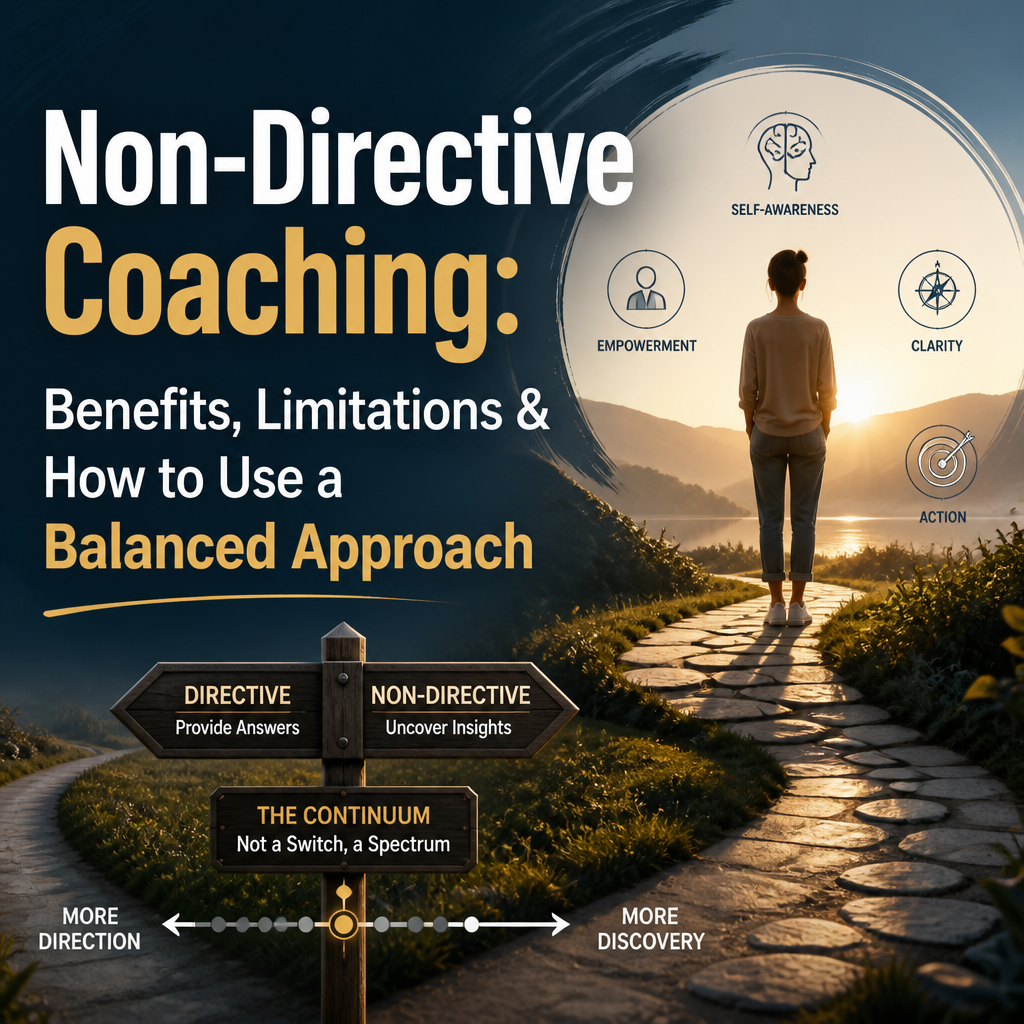
Non-Directive Coaching: Benefits, Limitations & How to Use a Balanced Approach
Non directive coaching is powerful when it helps clients take ownership of their thinking, decisions, and next steps. But it can also frustrate people who need more structure, speed, or clear guidance. The best results usually come from an intentional, balanced (hybrid) stance—where you use non-directive methods without losing support.
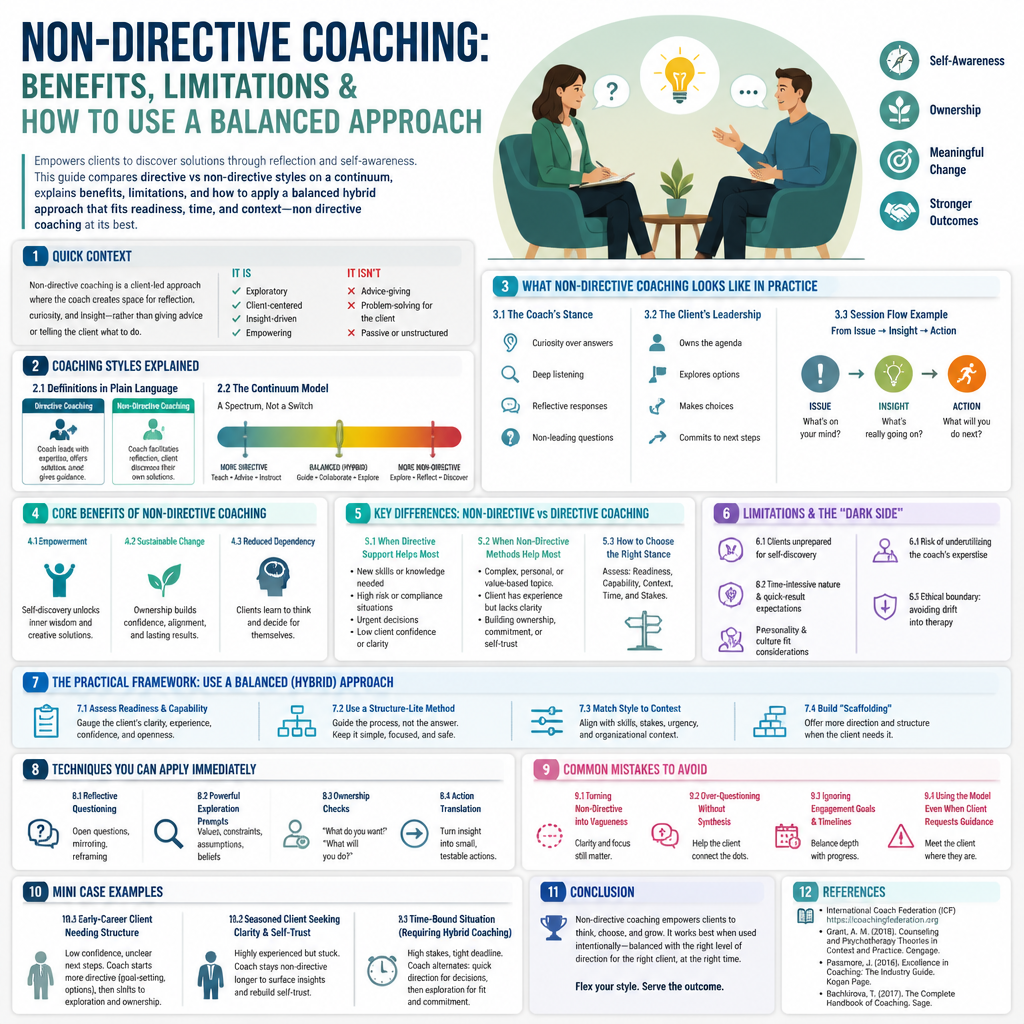
1. Quick context: what non-directive coaching is (and isn’t)
Non-directive coaching is a coaching style where the coach does not tell the client what to do, which decision to make, or what the “right” answer is. Instead, the coach creates conditions for the client to explore, reflect, and generate their own solutions.
In practice, that means:
- The client leads the session direction (goals, priorities, interpretations).
- The coach listens deeply, asks thoughtful questions, and supports sense-making.
- Insight becomes action through the client’s own choices and commitments.
Non-directive coaching is not “no guidance.” It’s not avoidance. The coach still holds a frame: ethics, structure-lite pacing, facilitation, and outcomes.
2. Coaching styles explained: directive vs non-directive
2.1 Definitions in plain language
Directive coaching emphasizes the coach’s input: suggestions, recommendations, specific strategies, or instructions.
Non-directive coaching emphasizes the client’s input: reflection, self-discovery, and decision ownership.
2.2 The continuum model: a spectrum, not a switch
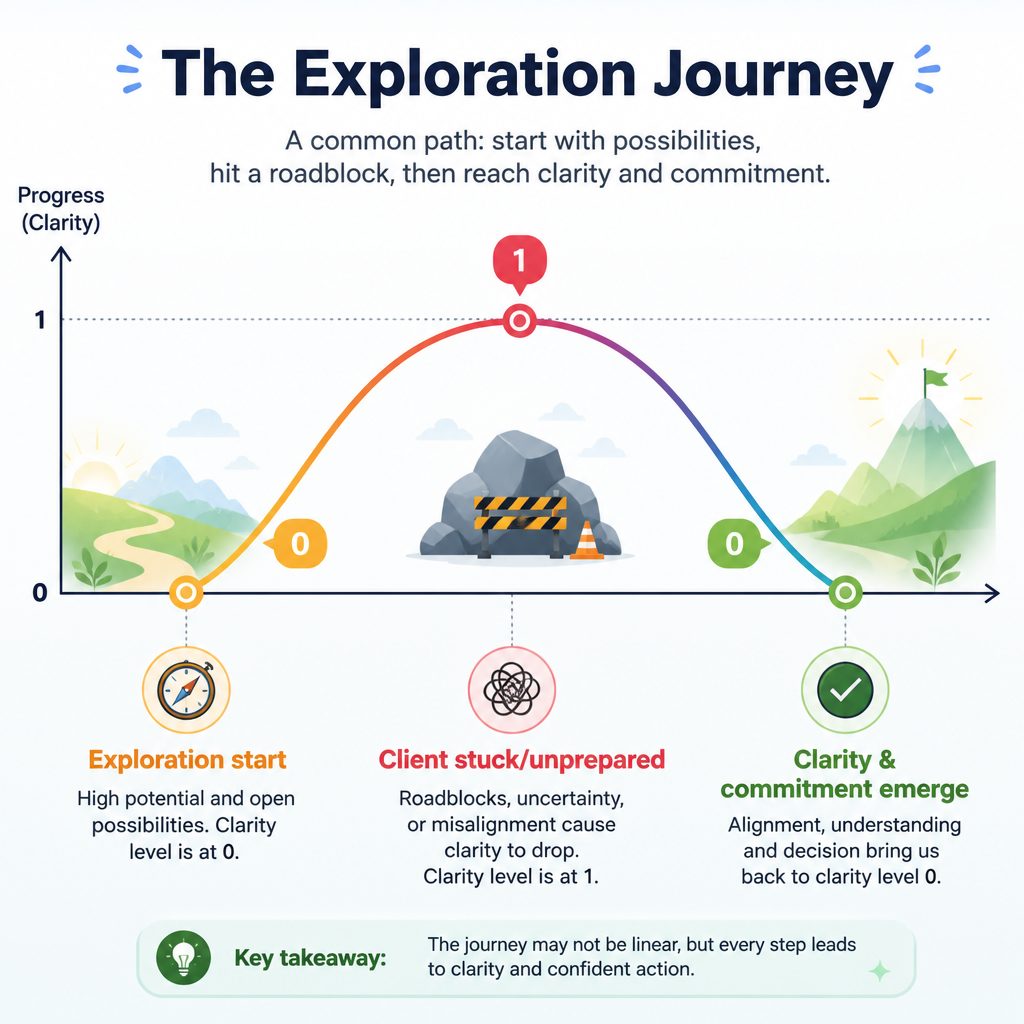
A common misconception is that coaching is either directive or non-directive. In reality, effective coaches work on a continuum. You can start with exploration, become more directive when the client is stuck or unprepared, and return to non-directive support once clarity and commitment emerge.
Think of it like scaffolding: you adjust support as the client gains capability.
3. What non-directive coaching looks like in practice
3.1 The coach’s stance: curiosity, reflection, non-leading questions
A non-directive coach typically:
- Uses curiosity over certainty.
- Asks open, non-leading questions.
- Mirrors language the client uses to highlight meaning.
- Reflects patterns (without diagnosing or prescribing).
- Supports the client in translating insight into practical commitments.
3.2 The client’s leadership: owning goals, choices, and next steps
The core expectation in non-directive coaching is client ownership. The client:
- Chooses what matters most (priority setting).
- Defines what “success” means for them.
- Selects options and assumes responsibility for outcomes.
3.3 Session flow example (from issue to insight to action)
Example flow:
- Issue (exploration): “What’s been hardest about this situation lately?”
- Meaning (reflection): “When you say ‘I can’t trust myself,’ what do you notice in your body or thoughts right before that happens?”
- Pattern (reframe): “What’s the story your mind keeps repeating? What evidence contradicts it?”
- Values (deeper motivation): “Which values are at stake here?”
- Decision points: “What choices are available? Which one feels most aligned?”
- Action (commitment): “What will you do this week—specifically—and what would make it ‘successful’?”
4. Core benefits of non-directive coaching
4.1 Empowerment through self-discovery and inner wisdom
Non-directive coaching strengthens the client’s capacity to find meaning and solutions internally. Instead of borrowing answers, clients learn how to think, interpret, and decide—an especially valuable skill for long-term growth.
4.2 Sustainable change via ownership, confidence, and alignment
Because the client generates the options and chooses the next steps, change tends to be more sustainable. Ownership builds confidence, and alignment with personal values makes follow-through more likely.
4.3 Reduced dependency: client learning to think and decide
When coached well, non-directive coaching reduces the “I need the coach to tell me what to do” dynamic. Clients begin to:
- Ask themselves better questions.
- Use reflection as a tool outside sessions.
- Trust their reasoning and learn from outcomes.

5. Key differences: non-directive coaching vs directive coaching
5.1 When directive support helps most
Directive coaching can be helpful when the client:
- Is new to the topic or lacks basic frameworks.
- Needs quick clarity to reduce anxiety or risk.
- Has a compliance, safety, or high-stakes constraint requiring clear guidance.
- Is stuck due to skill gaps (e.g., communication technique, prioritization method).
5.2 When non-directive methods help most
Non-directive coaching tends to be most effective when the client:
- Knows the problem context but struggles to decide or commit.
- Needs to clarify values, identity, or priorities.
- Feels constrained by others’ expectations.
- Wants to build self-trust and autonomy.
5.3 How to choose the right stance without “guessing”
Use three quick checks:
- Readiness: Does the client have enough skill and perspective to explore effectively?
- Stakes: Are there deadlines or risks that require more structure?
- Urgency: Is the client seeking understanding (slower) or execution (faster)?
6. Limitations and the “dark side” of non-directive coaching
6.1 Clients unprepared for self-discovery
One limitation is that some clients aren’t ready for a largely exploratory approach. If they expect direct guidance—or if they lack experience reflecting on thoughts and emotions—non-directive coaching can feel vague, slow, or even destabilizing.
6.2 Time-intensive nature and quick-result expectations
Non-directive work can require time to reach insight. If a client has a short timeline and expects immediate answers, the coaching must include more scaffolding (structured steps, decision aids, or interim experiments).
6.3 Personality and culture fit considerations
Not all contexts respond equally. Results-driven environments, hierarchical cultures, or clients who prefer clear direction may resist a non-directive stance unless you explicitly frame the process and show how it leads to action.
6.4 Risk of underutilizing the coach’s expertise
“Non-directive” can become an excuse to avoid using your knowledge. If you never offer useful inputs (e.g., models, examples, or options), the client may feel unsupported. The goal isn’t to be silent—it’s to avoid taking over the decision.
6.5 Ethical boundary: avoiding drift into therapy
Coaching is distinct from therapy. Non-directive coaching can still involve exploration, but coaches should avoid diagnosing, treating, or becoming a substitute for clinical support. If concerns appear therapeutic in nature, the ethical response is to refer appropriately and adjust scope.
7. The practical framework: use a balanced (hybrid) approach
7.1 Assess readiness and capability before going non-directive
Before leaning into non-directive questioning, confirm:
- Can the client articulate goals or at least identify the “direction”?
- Do they have enough self-awareness to reflect productively?
- Do they want exploration or do they need a plan?
7.2 Use a structure-lite method: guide the process, not the answer
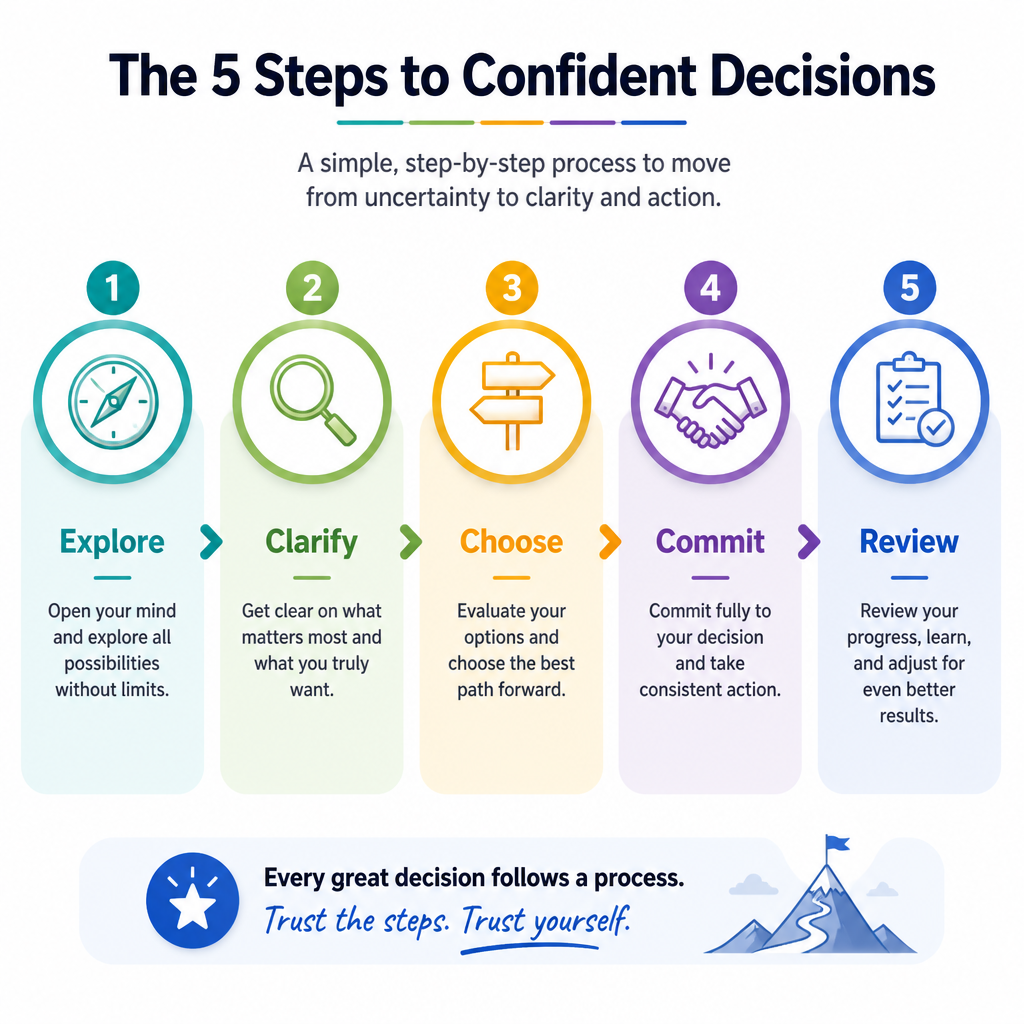
Hybrid coaching often looks like: process guidance with non-leading facilitation. You can offer a simple sequence such as: explore → clarify → choose → commit → review. Within that sequence, the client remains the decision-maker.
7.3 Match style to context: skills, stakes, and urgency
As a rule of thumb:
- If the client lacks a framework, provide one (directive) and then explore (non-directive).
- If the situation is time-sensitive, propose options and run a quick experiment (lightly directive) while still letting the client choose (non-directive).
- If the client is overloaded, start with reflection to reduce noise, then move to action.
7.4 Build “scaffolding”: when to offer more direction safely
Scaffolding can include:
- Giving example scripts for difficult conversations.
- Offering a decision matrix template.
- Suggesting a planning cadence or meeting structure.
- Recommending a small experiment rather than a final answer.
The key is that you’re expanding options—not taking the steering wheel.
8. Techniques you can apply immediately
8.1 Reflective questioning patterns (open questions, mirroring, reframe)
- Open question: “What does this bring up for you?”
- Mirroring: “You said ‘I’m afraid it won’t work.’ What’s underneath that fear?”
- Reframe: “If ‘consistency’ is the goal, what would ‘small but reliable’ look like?”
8.2 Powerful exploration prompts (values, constraints, assumptions)
- Values: “What value matters most here—freedom, security, growth, belonging?”
- Constraints: “What’s actually fixed vs what might be negotiable?”
- Assumptions: “What are you assuming will happen if you choose option A?”
8.3 Ownership checks: “What do you want?” “What will you do?”
When sessions drift into analysis without commitment, use ownership language:
- “What do you want?”
- “Which choice are you willing to test?”
- “What will you do by our next session?”
8.4 Action translation: from insight to experiment
Convert insight into a small, measurable step:
- Insight: “I avoid conflict when I fear rejection.”
- Experiment: “I’ll ask one clear question in my next meeting and observe what happens.”
- Review: “What did I learn about my fear and my actual results?”
9. Common mistakes to avoid
9.1 Turning non-directive into vagueness
Non-directive doesn’t mean unclear. If the client leaves without next steps, the approach failed. Use structure-lite sequencing and always close with a commitment.
9.2 Over-questioning without synthesis
Asking questions is not the same as helping the client think. Periodically synthesize themes and reflect patterns (“What I’m hearing is…”).
9.3 Ignoring engagement goals and timelines
Non-directive coaching still serves objectives. If the engagement expects measurable outcomes, align the coaching frame to those deliverables from day one.
9.4 Using the model even when the client requests guidance
If a client asks for advice, it doesn’t automatically mean they’re “doing it wrong.” In a hybrid approach, you can provide options, pros/cons, and examples—then still return the decision to them.
10. Mini case examples (short, practical scenarios)
10.1 Early-career client needing structure
Situation: A new manager feels overwhelmed and unsure how to prioritize tasks.
Balanced approach: Provide a simple prioritization framework (directive) and then ask reflective questions: “Which category drains you most? What would you like to change?” Non-directive coaching helps ownership of priorities.
10.2 Seasoned client seeking clarity and self-trust
Situation: A senior professional knows what’s possible but struggles to commit.
Balanced approach: Use non-directive questioning to explore values and fears (“What are you afraid will happen if you commit?”). Then translate insight into an experiment (“What’s the smallest commitment that proves alignment?”).
10.3 Time-bound situation where hybrid coaching is required
Situation: A leadership decision must be made in two weeks.
Balanced approach: Offer a decision matrix and recommended evaluation criteria (directive). Maintain non-directive facilitation by asking the client to choose the final criteria and decide the next step.
11. Conclusion: non-directive coaching works best when used intentionally
Non directive coaching helps clients discover their own solutions through reflection, self-awareness, and ownership. The difference between “effective non-directive coaching” and “the dark side” is intention and adaptability: match the coaching style to readiness, stakes, time constraints, personality, and desired outcomes.
If you remember one principle, make it this: guide the process, support the thinking, and let the client choose the action.
12. References (top research-inspired resources)
-
Jay Shetty Certification School — “Directive vs. Non-Directive Coaching: What’s the Difference?”
https://www.jayshettycoaching.com/blog/directive-and-non-directive-coaching -
KnowledgeBrief — “Directive vs Non-directive Coaching – Hot Topic”
https://www.knowledgebrief.com/hot-topic/directive-vs-non-directive-coaching -
Glenn Kiser (LinkedIn) — “The Dark Side of Non-Directive Coaching”
https://www.linkedin.com/pulse/dark-side-non-directive-coaching-glenn-kiser-jhsge